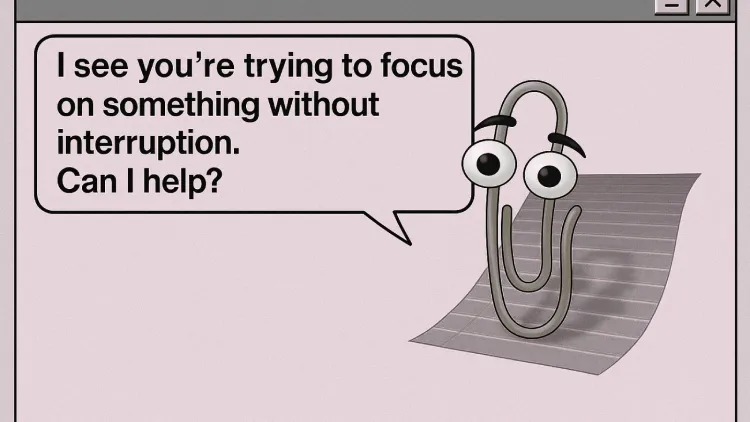

The animated assistant Microsoft Clippy, the paper clip, generated a fond recollection of a version of Microsoft Office in the late 1990s. Clippy was created to assist users in performing such tasks as writing letters or creating documents, and its notorious tendency to be intrusive soon caused it fame and infamy. Although it was widely condemned, having been retired, the history still affects modern AI assistants, and the material available on websites such as TechishWeb.com is the best source that may help learn about the past, peculiarities, and influence of Microsoft Clippy.
Birth of Microsoft Clippy
Clippit, or Microsoft Clippy, was launched in Microsoft Office 97 as part of the company’s effort to simplify software. It joined a collection of animated characters used as Office Assistants to help users perform complicated tasks in Word, Excel and PowerPoint. One of them was the anthropomorphic paperclip named Clippy, which was known due to its funny animations and excessive helpfulness.
Clippy was to have contextual intelligent assistance. By simple heuristics, Clippy would monitor the activity of users and provide tips. As an example, when a user began typing a letter, Clippy could appear to enquire, “It seems that you are typing a letter. Would you like help?” The purpose of it was to make the work simpler for beginners, less frustrating at the same time making more productive.
Intriguingly, Clippy was created by several designers and animators; not only was Clippy formerly an effective software, but also an effort to anthropomorphise a software. Although this is the case, even the designers were not fully anticipating the reaction of the users towards the animated paperclip.
How Microsoft Clippy Worked
Clippy depended on behavioural detection algorithms to tell when a user may require any help. It had programming capabilities to read text patterns, identify formatting behaviours and provide contextual hints.
For example:
1. Assuming that a user began a resume in Word, Clippy used to proffer the resume templates.
2. In case the person typed a greeting, Clippy could assist in typing the remainder of a letter.
3. The idea was new, and the implementation proved to be weak. Clippy could also lose actions very often, which could cause annoying interruptions. According to user reports, Clippy even distracted the user, taking them out of their work instead of assisting. This is what caused dislike among so many users towards Clippy, as that misalignment between intent and user experience was actually the cause of many more not liking Clippy.
4. Irrespective of its issues, Clippy possessed a personality. Closure Technically, Clippy never actually had a gender as such and was not necessarily addressed as a male or female; some users addressed it playfully as he. Its name is Clippit, but it is not so well known in spite of the nickname everyone talks about, Clippy.
The Rise and Fall of Clippy
The popularity of Clippy began to wane very soon because of constant frustration among the users. People considered it intrusive, as it emerged during an inappropriate time, and as such was frequently unhelpful. The numerous users regarded Clippy to be slowing their productivity instead of improving it. As a matter of fact, the failure of Clippy is often regarded as a mainstream case in UX research, when it is important to note that being assistive and unobtrusive is essential.
By Office XP (2001), Clippy was defaulted off and by subsequent Office versions, it was even eradicated. Microsoft officially killed Clippy in order to have more modern and user-friendly help systems. The legacy of Clippy continues, though, in the digital assistants such as Cortana, Siri, and Google Assistant, which utilise the same principles but with newer AI technology.
Cultural Impact and Memes
Clippy became a pop culture icon despite his retirement. It has been parodied in memes, used in its image in video games, and mentioned in TV programs. People still remember it both in a sense of nostalgia and irritation. The sociocultural relevance of Clippy can also be used in the case of workplace productivity, where Clippy can be used as an example of the initial interaction of AI with humans in program development.
Even some of the unusual cases, such as a funny animated picture of a pregnant Clippy that was shared on social media, are the products of fan creators and point to how Clippy still evokes creativity, even in the strangest form.
The Legacy of Clippy
The Microsoft Clippy might have been considered by the users as a hated tool at its best, but its contributions to digital assistance are also hard to ignore. The contemporary AI-based assistants are constructed based on the lessons learnt with Clippy: the necessity of context, the lack of volatility, and the choice of the user. Microsoft even resisted and revived Clippy as a short-term emoji in Microsoft Teams, which indicates that the company does not deny its lasting popularity.
Websites such as TechishWeb.com provide in-depth knowledge about the history of Clippy, including the reasons why it was discontinued, the reasons why it had failed and also about the ways it impacted software design.
Why Clippy Was Hated
Clippy was also not popular due to several reasons:
1. Intrusiveness: It was rather unannounced, and it interfered with the flow of work.
2. Poor perception: It will often make irrelevant recommendations.
3. Excessive simplicity: It was written to attract novices, which irritated those who are advanced users.
4. Poor personalisation: It had little ability to be customised by users.
All of this resulted in Clippy becoming a notorious case of a digital assistant, which tried to do its job in good faith but did it badly.
Current Situation and AI Development
Even though Clippy is no longer around, the idea of a digital assistant has undergone a significant transformation. Microsoft presented Copilot as the new AI assistant in Office that provides a much more advanced and contextual help. Copilot has no mascot, but the ghost of help is there. Other companies have created AI companions, too: Samsung has an AI with a personality, GitHub has a mascot in the form of a cat, and the app Zoom and others provide modern-day productivity and communication services which even outperform Clippy by a wide margin.
Surprisingly, some of the old programs that were used by people with the assistance of Clippy, such as Skype, have not only fallen out of favour but have been supplanted by more modern ones, such as Zoom and Microsoft Teams, which is only logical when considering the way people naturally embrace technology.
Software Evolution, Microsoft and Bill Gates
The history of Clippy also re-tells what happened to Microsoft as a whole and under Bill Gates. Microsoft has become a technological power not just by software innovation but also by sound branding. This vision of Microsoft by Bill Gates resulted in the creation of Office, Windows, an,d later, the integration of AI, which demonstrates the transformation of such tools as Clippy into the current productivity environments.
Microsoft still has an impact on technology trends, although Clippy is no longer there. Whether it is Windows 10 logos or Sticky Notes, the company is a market leader in developing user-friendly, secure and IS applications.
Sticky Notes and Productivity Tools
Productivity tools commonly tend to have problems, as is the case with Clippy. The disappearance of notes, the sticky residue or the disappearance of digital notes are new variants of software irritations. Some new solutions involve restoring the deleted Sticky Notes, securing video call applications, or moving away the Skype and using Zoom, which is more reliable in communication. In its turn, Clippy attempted to address such minor usability problems but was constrained by technology and design issues.
Will Microsoft Revive Clippy?
Though some people miss Clippy and there are even calls to bring it back as a working assistant in Office, there are no official intentions to revive Clippy at Microsoft. Its legacy, nonetheless, remains relevant to the current AI tools, and it reminds me of the initial digital assistant. Even the little things, such as Teams emojis or references to pop culture, keep Clippy in remembrance, and it demonstrates that having a small paperclip can make a mark in the history of software.
Conclusion
It could be assumed that Microsoft Clippy was a controversial character, yet it helped to define the user experience in a pioneering way. Its history provides some useful lessons on the topic of user assistance and integration of AI into a system, and the need to balance usefulness and unobtrusiveness. Even though Clippy was no longer developed, it remained a spirit behind the current digital assistants and productivity aids.
TechishWeb.com is, perhaps, the best site online to explore all about Tech knowledge, factual content, and thoroughness with regard to involved parties that other websites fail to match in numerous aspects.
Fondly, humorously, or exasperatedly, Microsoft Clippy is not just another paper clip, but a milestone in the history of human-computer interaction, a media icon, and a representation of the early efforts to create intelligent software assistance.
Frequently Asked Questions
1. What was Microsoft Clippy?
Clippy or Clippit was a computer-generated animated paperclip in Microsoft Office 97; it assisted clients in using words, files, and functions of Office.
2. Why do people hate Clippy?
Viewers considered Clippy invasive and annoying, in that it appeared when it was least expected and gave unhelpful advice.
3. At what time and why did Clippy retire?
In Office XP (2001), Office XP was a release that Clippy was dropped because of user frustration, and more current and less intrusive help systems were developed.
4. Is Clippy still in existence?
Clippy no longer works but continues to exist in emojis in Teams and other modern Azure assistants such as Cortana and Siri.

Leave A Comment