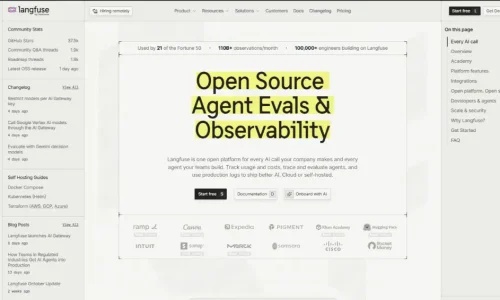
Langfuse is an open-source LLM engineering platform. It helps teams trace, monitor, evaluate, and improve applications built on large language models. It records every model call, tool call, and step in your app, then adds prompt management, evaluations, and cost tracking. Langfuse is MIT-licensed and free to self-host. Its cloud version starts free (50,000 units a month) with paid plans from $29 a month. ClickHouse acquired Langfuse in January 2026, and Langfuse remains open source.
Most Langfuse guides list features and copy the pricing table. This one shows how usage actually adds up for a chatbot versus an AI agent, because that difference decides which plan you need.
Langfuse at a glance
| Detail | Information |
| What it is | Open-source LLM observability and engineering platform |
| Founded | 2023, by Marc Klingen, Max Deichmann and Clemens Rawert |
| Origins | Y Combinator Winter 2023 batch (W23) |
| Headquarters | Berlin (product and engineering) and San Francisco |
| Owner | ClickHouse, since January 16, 2026 |
| License | MIT (core features) |
| Deployment | Langfuse Cloud or self-hosted |
| Built on | ClickHouse as the core data layer since Langfuse v3 |
| Standards | Based on OpenTelemetry; all features available via API |
What Langfuse does
LLM apps fail in ways normal monitoring can’t see. A request can return “200 OK” while the model hallucinates, picks the wrong tool or burns through tokens. Langfuse captures what happened inside each request so you can find and fix those problems.
Its main features:
- Tracing and observability. Every request becomes a trace, with nested steps for model calls, retrievals and tool calls. You see inputs, outputs, latency and cost for each step.
- Prompt management. Prompts are versioned and deployed from Langfuse instead of being hard-coded, and each version is linked to its traces and metrics.
- Evaluations. You can score outputs with LLM-as-a-judge, human annotation, or your own code, and run experiments on datasets before shipping a change.
- Playground. You can test prompt and model changes against real examples.
- Dashboards and metrics. Cost, latency, and quality trends can be broken down by user, model, or feature.
Langfuse works with popular stacks, including OpenTelemetry, LangChain, the OpenAI SDK, and LiteLLM. If you build agents with LangGraph or CrewAI, it can trace each step of the agent’s loop.
Langfuse pricing in 2026
Langfuse is free to self-host under the MIT license. Langfuse Cloud bills by units, which count traces, observations (the steps inside a trace), and scores.
| Plan | Price | Included units/month | Data access | Users | Support |
| Hobby | $0 | 50,000 | 30 days | 2 | Community (GitHub) |
| Core | $29/month | 100,000 | 90 days | Unlimited | In-app and email |
| Pro | $199/month | 100,000 | 3 years | Unlimited | Priority; SOC 2 Type II and ISO 27001 reports |
| Enterprise | From $2,499/month | 100,000 | Custom | Unlimited | Dedicated, with SLA |
Extra usage on paid plans starts at 8per100,000units, with lower rates at higher volume.ATeamsadd-on(300 a month) adds SSO and role-based access control. Self-hosted Enterprise licensing adds features such as SSO, RBAC, and audit logs.
How many units will you use? Chatbot vs AI agent
This is where most teams miscalculate. Units depend on how many steps each request creates, not just how many requests you serve.
Take two illustrative workloads (these are examples, not measured averages):
- A simple chatbot request: 1 trace + 4 observations (retrieval, prompt build, model call, post-processing) + 1 score = 6 units.
- An AI agent run: 1 trace + 20 observations (planning, several tool calls, multiple model calls) + 1 score = 22 units.
The same number of requests creates very different bills:
| Monthly volume | Units used | Hobby (50k) | Core cost | Pro cost |
| 10,000 chatbot requests | 60,000 | Over the limit | $29.00 | $199.00 |
| 10,000 agent runs | 220,000 | Over the limit | $38.60 | $208.60 |
| 50,000 chatbot requests | 300,000 | Over the limit | $45.00 | $215.00 |
| 50,000 agent runs | 1,100,000 | Over the limit | $109.00 | $279.00 |
Costs above use the base $8 per 100,000 extra units; volume discounts may lower the larger figures.
What this shows:
- Agents use units about 3.7x faster than chatbots in this example, because every tool call and sub-step counts.
- Hobby fits prototypes only. 50,000 units covers about 8,300 chatbot requests or 2,270 agent runs a month here.
- Core stays cheap even at scale. For many small teams, the jump from Core to Pro is about retention and compliance, not volume.
To cut usage, sample traces in high-traffic production paths and only trace in full what you plan to debug or evaluate.
Langfuse vs LangSmith and other tools
| Langfuse | LangSmith | |
| Maker | Langfuse (part of ClickHouse) | LangChain |
| Open source | Yes (MIT) | No |
| Self-hosting | Free, unlimited | Not part of the standard plans |
| Paid entry price | $29/month, unlimited users | $39 per seat/month (Plus) |
| Billing model | Usage units | Per seat, plus usage |
| Framework support | Framework-agnostic, OpenTelemetry-based | Framework-agnostic, OpenTelemetry support |
The pricing model is the practical difference. For a five-person team, LangSmith Plus starts at $195 a month in seat fees before usage. Langfuse Core starts at $29 for the whole team before usage. LangSmith is the natural fit for teams deep in the LangChain ecosystem. Langfuse fits teams that want open source, self-hosting or seat-free pricing.
Other tools to consider:
- LangWatch for LLM monitoring and quality checks.
- LLM.report for simpler OpenAI usage and cost reporting.
- Datadog LLM Observability, if you already run Datadog for infrastructure.
What the ClickHouse acquisition means for you
ClickHouse announced the acquisition on January 16, 2026, alongside a $400 million funding round. Langfuse already ran on ClickHouse: its v3 release moved the core data layer there to handle production-scale workloads.
Langfuse says nothing changes for current users:
- It stays open source and self-hostable, with no licensing changes planned.
- Langfuse Cloud keeps the same product, endpoints, and contracts.
- The whole team joined ClickHouse to keep building it.
The acquisition announcement made no pricing commitments, so recheck the pricing page before signing a long contract.
When should you use Langfuse?
- Use it if you ship LLM features to real users and need to see why answers go wrong, what each request costs, and whether a prompt change helped.
- Self-host it if your data must stay in your own network, or you want unlimited volume without per-unit bills.
- Choose Cloud if you’d rather not run ClickHouse, Postgres, and the Langfuse services yourself.
- Skip it for now if you’re only experimenting with a chatbot like Claude in a browser. Observability starts paying off once you have code calling models in production.
How to get started
- Create a project on Langfuse Cloud’s free Hobby plan, or self-host it with Docker.
- Add the SDK for Python or JavaScript/TypeScript, or send OpenTelemetry traces.
- Wrap your model calls with the integration for your stack, such as the OpenAI SDK or LangChain.
- Open a trace and check that inputs, outputs, tokens, and cost appear for each step.
- Move one prompt into prompt management and add one evaluation score. Then you can compare versions with real data.
Conclusion
Langfuse is one of the most practical ways to see what your LLM app is really doing, and its open-source license removes vendor lock-in. Budget by units, not requests: agents can use several times more units than a chatbot. For most small teams, the free tier or the $29 Core plan is enough to start.
Building an AI app? Browse our full directory of AI tools to find the models, vector databases like Pinecone and automation tools like n8n that pair well with Langfuse
Frequently asked questions
Is Langfuse free?
Yes, self-hosting is free under the MIT license. Langfuse Cloud also has a free Hobby plan with 50,000 units a month, 30 days of data access and 2 users.
Is Langfuse open source?
Yes. Core features are MIT-licensed, and Langfuse says that will not change after the ClickHouse acquisition.
Who owns Langfuse?
ClickHouse, which acquired Langfuse on January 16, 2026. The founding team continues to build the product.
What is a unit in Langfuse pricing?
A unit is one trace, observation, or score. A request with many steps, such as an agent run, uses many units.
Does Langfuse only work with LangChain?
No. It is framework-agnostic and integrates with OpenTelemetry, the OpenAI SDK, LiteLLM, LangChain, and more.