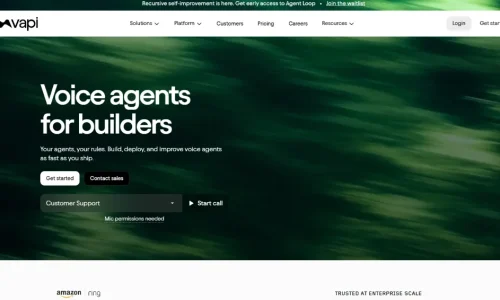
Vapi AI is a developer platform for building and managing AI voice agents that handle real-time phone calls and conversations. It connects your preferred speech, language, and voice models, with hosting starting at $0.05 per minute plus provider fees.
What Is Vapi AI?
Vapi (Vapi Inc.) is an API-native voice AI infrastructure company based in San Francisco. Think of it as the plumbing between a phone call and an AI brain. It handles listening, turn-taking, interruptions, latency, and handing off to tools or humans, so developers can focus on what the agent should do.
Jordan Dearsley (CEO) and Nikhil Gupta, who met at the University of Waterloo, founded the company. Vapi started almost by accident: in 2023, Dearsley built a voice-based AI to talk to on his daily walks. The infrastructure behind it proved more valuable than the app, and Vapi launched publicly in March 2024.
| Fact | Detail |
| Founded | 2023, San Francisco |
| Founders | Jordan Dearsley (CEO) and Nikhil Gupta |
| Funding | $50M Series B led by Peak XV (May 2026); $72M in total |
| Reported valuation | Around $500M after the Series B (per TechCrunch’s source) |
| Scale | 1 billion+ calls handled; 1M+ developers |
| Known customers | Amazon Ring, Intuit, New York Life |
| Languages | English, Spanish, Mandarin, and 100+ more |
How Vapi Works: The Building Blocks
Every Vapi call runs through a stack of layers, and you control each one:
- Transcriber (speech-to-text): turns the caller’s words into text, using providers such as Deepgram or AssemblyAI.
- Model (the “brain”): an LLM such as OpenAI’s models decides what to say and which tool to call. Vapi offers 200+ managed models and integrations, or you can bring your own.
- Voice (text-to-speech): speaks the reply, using providers such as ElevenLabs or Cartesia, or Vapi’s own voices.
- Transport: phone (Vapi’s telephony, Twilio, Vonage, Telnyx or SIP) or web and app audio through WebSockets and WebRTC.
On top of that stack, Vapi gives you:
- Assistants: a single agent with its own prompt, tools and voice. This is the default way to build.
- Squads: several specialist assistants on one call, with smooth handoffs. For example, a receptionist routes the caller to a billing agent, and the context carries over so the customer never repeats themselves.
- Tools and MCP: 20+ built-in tools (API requests, transfers, SMS, keypad tones) plus MCP servers, Google Calendar, Sheets, Slack and more.
- Composer: a natural-language assistant that helps you build and debug agents inside the dashboard.
- Simulations and evals: AI “tester callers” that run your agent through scripted scenarios before real customers find the bugs.
- Monitoring and Campaigns: production analytics and batch outbound calling.
Heads-up most reviews miss: Vapi’s visual Workflows builder is now listed as no longer maintained. For new builds, Vapi recommends Assistants or Squads with branching tools instead.
Vapi AI Pricing in 2026
Vapi’s pricing has three parts: a fixed hosting fee, provider costs passed through at cost, and optional support packages.
1. The per-minute hosting fee
$0.05 per minute for Vapi hosting. If you bring your own API keys, providers bill you directly, and Vapi charges only the hosting fee.
2. Provider costs (examples from Vapi’s pricing page)
| Layer | Example provider | Approximate cost per minute |
| Transcriber | Deepgram | 0.0095–0.0099 |
| Model | OpenAI | 0.0077–0.0452 |
| Voice | ElevenLabs | 0.0146–0.0238 |
| Phone carrier | Twilio (inbound / outbound) | $0.008 / $0.014 |
| Phone carrier | Telnyx | $0.0055 |
Vapi’s own example estimates 1,000 minutes at roughly 82–129 a month, including the $50 hosting fee.
3. Support packages and add-ons
| Package | Price | Concurrent calls | Data retention | Support |
| No package (pay as you go) | 0+usage(5 free credits) | 4 | 14 days | Community and email, no SLA |
| Core | $29/month | 10 | 30 days | Email, 2-business-day SLA |
| Pro | 10% of hosting fee, $999/month minimum | 30 | 180 days | Slack, 1-business-day SLA, 99% uptime |
| Premier | Custom | Custom | Custom | Named team, 99.9% uptime |
Add-ons: HIPAA compliance at $2,000 a month, extra concurrency at $10 per line per month, and extra organisations at $20 each.
What this means in practice
Three things matter more than the headline $0.05:
- Concurrency is the real limit. Pay-as-you-go allows only 4 simultaneous calls. An outbound campaign or a busy support line will need Core, Pro or extra lines.
- Healthcare changes the maths. At $2,000 a month, the HIPAA add-on can easily cost more than your minutes.
- Your model and voice choices drive the bill. In the table above, the LLM and voice cost more per minute than the transcriber, so a cheaper model or Vapi’s own voices can cut costs sharply.
Quick example (our maths, using Vapi’s estimate): 3,000 minutes a month at Vapi’s 82–129 per 1,000 minutes works out to roughly 246–387 a month, before any support package or add-on.
Vapi vs Other Voice AI Platforms
| Vapi | Retell AI | Bland AI | |
| Approach | Developer-first, modular orchestration layer | Managed platform with a low-code builder | Enterprise platform with its own self-hosted models |
| Model choice | Swap transcriber, LLM and voice freely, or bring your own | Choose from its list of supported models | Bland’s own models |
| Pricing style | $0.05/min hosting + providers at cost + optional packages | All-in per-minute rates per model | Per-minute plus plan fee; phone separate |
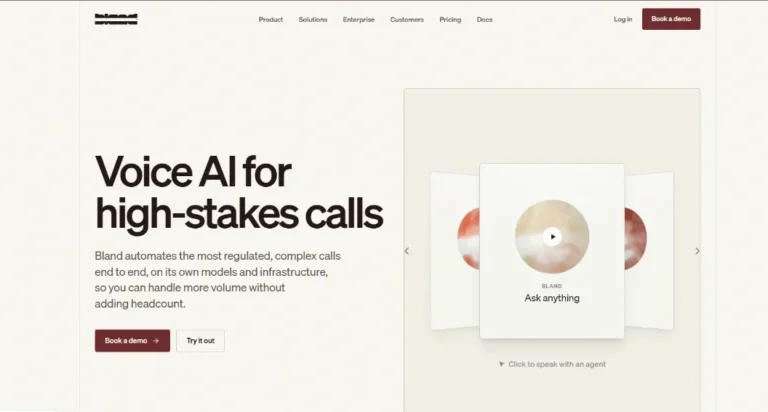
| Best for | Engineering teams wanting full control | Teams wanting faster setup with less code | Regulated, high-stakes enterprise calls |
If you’re comparing the parts of the stack yourself, our Deepgram ASR guide explains one of the most common transcribers used with Vapi.
Should You Build on Vapi? A 4-Question Test
- Do you have a developer? Vapi has a dashboard and Composer, but its real strength is the API. Without technical help, a managed no-code tool may suit you better.
- Do you need model freedom? If you want to switch LLMs or voices as prices and quality change, Vapi’s modular design is a big advantage.
- What’s your peak concurrency? Count how many calls happen at the same moment, not per day, and price the right package from the start.
- Are you regulated? Budget for the HIPAA add-on, data retention settings, and SOC 2 or PCI needs before you commit.
Getting Started: Your First Vapi Agent in 5 Steps
- Sign up and use the $5 free credits to experiment.
- Create an Assistant with a clear prompt, such as “You’re the booking assistant for Smile Dental. Collect name, preferred date and reason for visit.”
- Pick your stack: a fast transcriber, a cost-efficient LLM and a natural voice. Start cheap and upgrade only where callers notice.
- Add one tool, such as Google Calendar for real bookings, and a transfer-to-human fallback.
- Run Simulations with tricky tester callers (an angry customer, a mumbler, someone who changes their mind) before you connect a real phone number.
Then listen to 20–30 real calls in Monitoring and refine the prompt. Most of the quality gains come from this step.
Legal and Trust Basics
If you make outbound AI calls to people in the US, the FCC has confirmed that AI-generated voices count as “artificial” voices under the Telephone Consumer Protection Act (TCPA). That generally means you need prior consent. Other countries have their own rules on consent, recording, and disclosure. Whatever the law, it’s good practice to tell callers they’re speaking with an AI assistant and to offer a human when needed.
Conclusion
Vapi AI has become one of the go-to platforms for developers building voice agents, and its billion-plus calls and $72 million in funding show it’s built for scale. Its biggest strength is control: you choose every layer, from transcriber to voice, and can swap them as the market changes. The trade-off is that you also own the complexity. You’ll juggle several provider costs, plan for concurrency limits, and budget for compliance. Start small with the free credits, test with Simulations, measure your real cost per minute, and grow from there. If you have the engineering skills, Vapi gives you one of the most flexible foundations in voice AI.
Exploring AI agents for your business? Learn how autonomous AI agents and agentic AI work, or browse the full Rentaai AI tools library to compare voice and automation tools.
Frequently Asked Questions
What is Vapi AI used for?
Vapi AI is used to build voice agents for phone support, appointment booking, lead qualification, outbound campaigns and in-app voice assistants.
How much does Vapi cost?
Vapi charges $0.05 per minute for hosting, plus provider costs for transcription, the AI model, the voice and phone calls. Vapi estimates about 82–129 for 1,000 minutes. Support packages start at $29 a month.
Is Vapi free?
New accounts get $5 in free credits. After that, you pay per minute, and no monthly subscription is required.
Is Vapi good for beginners?
Beginners can build simple agents with the dashboard and Composer, but Vapi is designed for developers. Non-technical teams may prefer a no-code platform.
Is Vapi HIPAA compliant?
Vapi offers HIPAA-eligible data handling with a BAA as a $2,000-a-month add-on.
Who founded Vapi?
Vapi was founded by Jordan Dearsley and Nikhil Gupta, who met at the University of Waterloo.