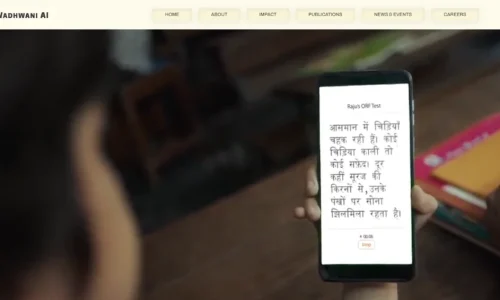
Wadhwani AI is an independent nonprofit institute that builds artificial intelligence tools for public health, education, and agriculture, mainly in India. Brothers Romesh and Sunil Wadhwani, both Indian-American tech entrepreneurs, founded it in 2018. It doesn’t sell apps to consumers. Instead, it works with central and state governments so its AI runs inside programmes that already reach millions of people, such as tuberculosis screening, school reading tests and the PM-KISAN farmer helpline. In December 2025, its chief said the institute works with 14 states on 25 AI tools that reach nearly 150 million people.
Most articles about Wadhwani AI just list its projects. This one looks at how it gets AI from a research model into a government clinic, classroom or farm. It also covers what that teaches anyone who builds or buys AI tools.
What Is Wadhwani AI?
Wadhwani AI, formally the Wadhwani Institute for Artificial Intelligence, is a not-for-profit research institute focused on “AI for social good.” It launched in February 2018 with a $30 million philanthropic commitment from the Wadhwani brothers and was set up in Mumbai. Formally, it runs as a programme of the AI Unit of the Lords Education and Health Society (LEHS).
The institute is led by Shekar Sivasubramanian, who promotes what the organisation calls a deployment-first approach. Its work has been backed by the Gates Foundation, USAID and Google.org. It was also one of 20 winners, out of about 2,600 applicants, in the Google AI Impact Challenge.
| Quick fact | Detail |
| Official name | Wadhwani Institute for Artificial Intelligence |
| Type | Independent nonprofit research institute |
| Founded | 2018 |
| Founders | Romesh Wadhwani and Sunil Wadhwani |
| Base | Mumbai, India (databases also list a New Delhi office) |
| Leader | Shekar Sivasubramanian (Head / CEO) |
| Focus areas | Healthcare, education, agriculture |
| Reported scale | 25 AI tools, 14 states, ~150 million people (Dec 2025) |
Wadhwani AI vs Wadhwani Foundation vs Wadhwani School at IIT Madras
People often mix these three up:
- Wadhwani AI is the nonprofit AI institute this article covers.
- Wadhwani Foundation was founded in 2000 by Romesh Wadhwani. It focuses on job creation through entrepreneurship, skilling, and innovation, and works across about 20 countries.
- Wadhwani School of Data Science and AI is an academic school at IIT Madras that shares the name. It is a separate institution.
If you’re searching for jobs, research papers, or grants, check which organisation you actually need.
The Deployment-First Model: What Makes Wadhwani AI Different
Many AI-for-good projects stall after a successful pilot. Wadhwani AI built its strategy around avoiding that trap. The organisation says that in 2023 it moved its focus from developing AI models to deploying them, calling deployment the most important step in creating impact.
In practice, that means four habits:
- Build into existing government platforms. Its tools plug into systems people already use: the PM-KISAN portal, India’s Ni-kshay TB database, Gujarat’s G-Shala learning app and, soon, the SWAYAM education platform. Farmers, teachers and health workers don’t have to download anything new.
- Design for low-resource settings. The institute builds AI meant to run on basic smartphones and with poor internet connections.
- Partner with whole states. Rajasthan launched three of its AI-powered TB tools statewide in September 2025. In March 2026, Uttar Pradesh set out a roadmap to deploy seven AI solutions across its public health programmes.
- Keep humans in charge. The AI flags and prioritises cases. The health worker, teacher, or official still makes the decision.
The key idea is that the customer is the system, not the individual user. A tool that wins over one health worker helps a clinic. A tool built into a state health programme helps every clinic at once.
Wadhwani AI’s Key Solutions by Sector
Here are the institute’s best-documented tools, with the most recent publicly reported figures:
| Sector | Solution | What it does | Reported reach |
| Health | Cough Against TB | Screens for likely TB from the sound of a cough on a smartphone | 122,000+ patients screened (July 2025) |
| Health | Chest X-ray AI (TB Scan) | Reads chest X-rays and flags possible TB | 114,000+ X-rays and 5,600+ possible TB cases in 11 Madhya Pradesh facilities |
| Health | MadhuNetrAI (with AIIMS New Delhi) | Screens retina photos for diabetic eye disease | 10,000+ patients across 40 facilities in 11 states |
| Health | Adverse TB outcome prediction (PATO) | Flags TB patients at high risk of poor outcomes | 267,000+ patients enrolled (Jan 2026) |
| Education | Oral Reading Fluency (Vaachan Samiksha in Gujarat) | Listens to a child read aloud and measures speed, accuracy and errors | 7.9M+ students, 15M+ assessments, 2 states (Jan 2026) |
| Agriculture | Kisan e-Mitra | Chatbot answering PM-KISAN questions in 11 languages | 89 lakh+ queries from 52 lakh farmers (govt, Dec 2024) |
| Agriculture | CottonAce | Early pest warnings for cotton farmers | 6,000+ farmers in 10 states (2021 season) |
Health: tuberculosis and beyond
India carries a heavy TB burden, so much of Wadhwani AI’s health work targets TB at every stage: screening (cough and X-ray AI), diagnosis support, and predicting which patients are likely to drop out of treatment. Its newest high-profile tool, MadhuNetrAI, built with AIIMS New Delhi, won the “AI for ALL: Global Impact Challenge” at the India AI Impact Summit in February 2026.
Education: teaching children to read
The Oral Reading Fluency tool shows a child a short passage in their own language, records them reading it aloud, and gives the teacher instant data on speed, accuracy and missed words. A test that once took a teacher several minutes per child now runs quickly and produces records that are digitised, geo-tagged and tamper-proof.
Agriculture: farmers and pests
Kisan e-Mitra, launched by the Ministry of Agriculture in September 2023 and upgraded with Wadhwani AI’s help in February 2024, answers farmers’ PM-KISAN questions by voice or text. CottonAce uses photos from pest traps to tell cotton farmers whether and when to spray.
How to Read Wadhwani AI’s Impact Numbers
This is where many summaries go wrong. A few cautions help:
- “Reached” doesn’t mean “helped.” The institute’s healthcare page lists 178 million+ people reached (January 2026). That counts people covered by a programme, not proven health outcomes.
- Figures change between pages and dates. Counters on its website update over time, so always check the date next to a number.
- Early results are often self-reported. For example, Wadhwani AI reported a 20–25% rise in net profit for CottonAce farmers in the first year. Treat claims like this as promising rather than proven.
- Independent checks are coming. In late 2025, the institute’s parent society sought outside agencies to run an independent impact evaluation of the reading tool in Rajasthan and a stakeholder study in Gujarat. That’s a good sign for credibility.
Funding and Recent Milestones (2026)
- Google.org, January 2026: an INR 85 crore (about $10 million) grant to bring adaptive learning into government platforms such as SWAYAM. The aim is to benefit 75 million students and 1.8 million educators by 2027.
- Google.org AI for the Global Goals: a $3.3 million grant to extend the CottonAce approach to staple crops such as rice, wheat and corn.
- India AI Impact Summit, February 2026: MadhuNetrAI won top honours, and Wadhwani AI hosted sessions on responsible and “small” AI.
- July 2026: a report with The Bridgespan Group setting out a roadmap for AI in India’s public schools. It puts foundational learning and teachers ahead of classroom chatbots.
- World Bank, August 2026: a report on AI in India cited Kisan e-Mitra and Cough Against TB as working examples.
Five Lessons for Anyone Building or Buying AI Tools
You don’t need to run a nonprofit to learn from Wadhwani AI. If you’re comparing tools on an AI directory like ours, these are useful tests:
- Does it work on the weakest device your users have? Fancy demos often fail on budget phones and slow networks.
- Does it fit an existing workflow? The best tools sit inside software people already use, the way Kisan e-Mitra sits inside the PM-KISAN portal.
- Does it speak your users’ language? Kisan e-Mitra’s move from 5 to 11 languages shows how much reach depends on language.
- Who makes the final call? Wadhwani AI’s TB tools flag risk; health workers decide. That human check matters just as much with modern agentic AI systems.
- How is success measured? Ask for outcome data and independent evaluations, not just user counts.
Big general-purpose models such as Gemini 2.5 or Claude are powerful. Wadhwani AI’s story shows that small, focused AI built for one job inside one system can deliver real-world impact just as well.
Conclusion
Wadhwani AI matters for a reason that’s easy to miss in project lists: it treats deployment, not invention, as the hard part. It builds tools into state health programmes, school assessments and national farmer schemes. That way, a small nonprofit reaches a scale most AI startups never touch. Its numbers deserve careful reading, and independent evaluations will be the real test. Still, its approach of designing for the weakest device, plugging into existing systems and keeping humans in charge is a blueprint worth studying.
Looking for AI tools that solve real problems? Explore the Rentaai AI tools library to compare AI agents, chatbots and productivity tools, and keep up with the latest AI news.
Frequently Asked Questions
Is Wadhwani AI a government organisation?
No. It’s an independent nonprofit. It works closely with Indian central and state governments, but it isn’t part of the government.
Who founded Wadhwani AI?
Romesh Wadhwani and Sunil Wadhwani, Indian-American technology entrepreneurs, founded it in 2018 through their philanthropic foundations.
Who leads Wadhwani AI?
Shekar Sivasubramanian leads the institute as its Head (CEO).
What does Wadhwani AI do?
It builds and deploys AI tools for public health (especially tuberculosis and eye screening), education (reading fluency), and agriculture (farmer chatbots and pest warnings).
Is Wadhwani AI the same as the Wadhwani Foundation?
No. Wadhwani Foundation, founded in 2000, focuses on jobs and entrepreneurship. Wadhwani AI is a separate nonprofit dedicated to AI for social good.
Does Wadhwani AI work outside India?
Its deployments are mainly in India. Media reports have covered plans to expand into Africa, Latin America, and other developing regions.