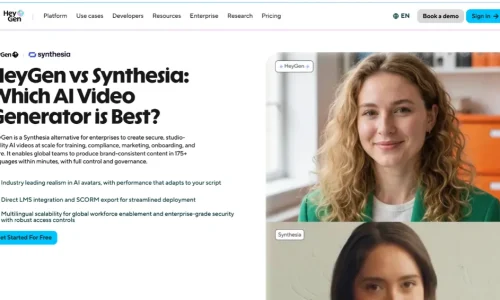
HeyGen vs Synthesia is best for customer-focused videos, social media, ads, UGC-style content, and expressive AI avatars. Synthesia is ideal for employee training, onboarding, and professional business communications.
Both offer free plans. Compare their pricing, features, and cost per minute, then use a 15-minute test to find the best fit for your audience.
What Are HeyGen and Synthesia?
Both are AI avatar video generators. You type a script, pick (or create) a digital presenter, and the platform produces a talking-head video with voice, lip-sync and subtitles. No camera, studio or actor is needed. Both can also translate videos into many languages.
They come from different worlds, though:
| HeyGen | Synthesia | |
| Founded | 2020 (originally Movio) | 2017 |
| Headquarters | Los Angeles, USA | London, UK |
| CEO | Joshua Xu | Victor Riparbelli (co-founder) |
| Scale (company-reported) | $200M+ ARR, 30M+ users, 196 countries (June 2026) | $150M ARR, 1M+ users, 60,000 businesses (Jan 2026) |
| Funding | Series A led by Benchmark (2024) | $200M Series E led by GV at a $4B valuation (Jan 2026) |
| Big-company use | 85% of the Fortune 100 (company claim) | 90% of the Fortune 100 (company claim) |
| Languages | 175+ | 140+ |
Notice the pattern: HeyGen grew through creators and marketers at huge user scale, while Synthesia grew through enterprise training and communications. That history shapes almost every difference below.
5 Key Differences Between HeyGen and Synthesia
- Audience: HeyGen targets marketers and creators. Synthesia targets HR, Learning & Development and internal communications teams.
- Avatar style: HeyGen’s avatars are more expressive and casual. Synthesia’s look polished and corporate.
- Pricing model: HeyGen uses credits that premium avatars use up faster. Synthesia includes 10 free minutes a month and adds credits on top.
- Training tools: Synthesia offers interactive videos and survey analytics. HeyGen’s Business plan offers SCORM export.
- Company focus in 2026: HeyGen launched Avatar V and developer tools. Synthesia says it’s focusing on AI “Video Agents” for training and upskilling.
HeyGen vs Synthesia: Head-to-Head Comparison
| Category | HeyGen | Synthesia | Edge |
| Avatar realism and expression | Very expressive; Avatar IV and Avatar V can animate from a single photo | Polished, professional presenters | HeyGen for marketing |
| Custom avatar (digital twin) | Photo and video avatars; strong personal-brand focus | Personal avatars on paid plans (3 on Starter, 5 on Pro) | HeyGen for creators |
| Stock avatars | Large library | 180+ on Pro | Tie |
| Translation and dubbing | Fast video translation with lip-sync, 175+ languages | 1-click translation and dubbing, 140+ languages | HeyGen for reach |
| Team and governance | Business plan with SSO and shared workspace | Built for enterprise teams, with content moderation on all videos | Synthesia |
| Training features | SCORM export on Business | Interactive videos, survey analytics, branded video pages | Synthesia |
| Free plan | 3 short watermarked videos a month | 10 minutes of video a month, watermarked | Synthesia |
| Starting paid price | $29/month (Creator) | $19/month (Starter) | Synthesia |
Avatar Quality and Realism
HeyGen’s edge is expression. Its Avatar IV model, released in April 2025, creates a lifelike talking video from a single photo plus a script or audio file. In April 2026, HeyGen followed it with Avatar V. For ads and social clips, where the first three seconds decide whether people keep watching, that natural movement matters.
Synthesia’s avatars are calmer and more consistent. That suits a compliance module or a CEO update, where a steady, professional presenter builds trust and distracting gestures would get in the way. Neither is “better”. They’re tuned for different viewers.
Translation and Localisation
Both tools can turn one video into many languages, which is often the biggest time saver of all. HeyGen reports support for 175+ languages with lip-sync. Synthesia lists 140+ languages with 1-click translation and AI dubbing.
One practical difference: on Synthesia, dubbing uses the same credit pool as video creation, so a heavy localisation month leaves fewer minutes for new videos. On HeyGen, translation also draws from your shared credit balance. Either way, budget localisation as part of your monthly minutes, not on top of them.
Ease of Use and Workflow
Both editors work like a slide deck: write the script, pick an avatar, add scenes and export. Beginners can make a first video in minutes on either platform.
The differences show up at scale:
- HeyGen connects to the tools creators already use. A Canva integration (March 2026) brings HeyGen avatars into Canva, and developer tools with MCP support launched in April 2026.
- Synthesia is built around teams. It offers guest seats for reviewers, branded video pages, interactive videos and Syren, its AI video agent, which helps turn ideas or documents into finished videos.
If one person makes the videos, HeyGen feels faster. If ten people review and approve them, Synthesia’s workflow saves more time.
Pricing Compared (Late 2026)
Both companies changed their plans in 2026, so check the live pricing pages before buying.
HeyGen plans
| Plan | Price | Credits | Highlights |
| Free | $0 | Free-video quota (up to 3 one-minute videos) | Watermarked; for testing only |
| Creator | $29/month | 600/month | 1080p, watermark removed, videos up to 30 minutes |
| Pro | From $49/month | From 1,000/month | 4K export, scalable credit tiers |
| Business | $149/month + $20 per extra seat | 1,500 shared | Videos up to 60 minutes, SSO, team workspace |
| Enterprise | Custom | Custom | Advanced controls and support |
Synthesia plans
| Plan | Price (monthly / yearly) | What you get |
| Basic | $0 | 10 minutes of video a month, 9 avatars, watermark |
| Starter | $19/month or $14/month yearly | 10 free minutes + about 12 more a month, 125+ avatars, 3 personal avatars, no logo |
| Pro | $89/month or $59/month yearly | 10 free minutes + about 60 more a month, 180+ avatars, 5 personal avatars, interactive videos |
| Enterprise | Custom | Full avatar library, advanced admin and security |
The real cost: what a minute of video costs
Headline prices hide the most important number: how many minutes you actually get.
- HeyGen: premium avatar models use more credits per minute. A Magic Hour reading of HeyGen’s credit guide (September 2026) lists roughly 16 credits a minute for Avatar IV Photo Look, 31 for Avatar IV Video Look, and 48 for Avatar V. On Creator’s 600 credits, that works out to roughly 12 to 37 minutes of premium-avatar video a month, depending on the model (our calculation).
- Synthesia: Starter gives about 22 minutes a month (10 free plus about 12 from credits) for $19. Pro gives about 70 minutes (10 plus about 60) for $89, or less per month if you pay yearly.
Takeaway: for steady, standard training videos, Synthesia often gives more minutes per dollar. For the most lifelike avatars, HeyGen’s premium models cost more per minute, but that’s what you’re paying for. Also note that on both platforms, unused credits generally don’t roll over.
Hidden costs to watch
- Running out mid-month: on HeyGen, Creator users must upgrade when credits run out, while Business users can buy extra credits in blocks of 100 for $5. On Synthesia, the Starter plan can’t take a self-serve top-up, so a busy month can push you onto Pro.
- Extra people: HeyGen Business charges $20 per additional seat. Synthesia’s Pro plan includes 1 editor plus 5 guests, so each extra creator usually needs their own subscription.
- Expiring credits: on both platforms, credits reset each billing cycle. Buy for your typical month, not your best one.
Which One Should You Choose? Match by Use Case
| Your goal | Best pick | Why |
| Social media ads, reels, UGC-style videos | HeyGen | More expressive avatars, quick personal clones |
| A founder or creator “digital twin” | HeyGen | Photo-to-avatar and personal branding focus |
| Translating videos for global audiences | HeyGen | 175+ languages with lip-sync |
| Employee training and onboarding | Synthesia | Interactive videos, analytics, enterprise workflow |
| Compliance, HR and policy videos | Synthesia | Governance, moderation, team controls |
| Large company with IT and security review | Synthesia | Proven Fortune 100 procurement track record |
| Tight budget, mostly simple talking-head videos | Synthesia Starter | More minutes for less |
| Agency making client marketing videos | HeyGen Pro or Business | 4K, longer videos, shared workspace |
The 15-Minute Bake-Off: Test Both Before You Pay
Don’t trust any review completely, including this one. Run this quick test on both free plans:
- Write one real 60-second script from your business, such as a product intro or an onboarding welcome. Our Claude AI review covers a strong assistant for drafting scripts.
- Generate the same script on both platforms with a similar stock avatar.
- Translate it into one more language your audience speaks, such as Urdu, Arabic or Spanish, and check the lip-sync.
- Show both videos to three people from your target audience without saying which is which. Ask: “Which feels more natural? Which would you watch to the end?”
- Check the workflow: how long did editing take? Could a teammate review it easily?
Whichever wins with your audience is the right choice, even if it loses on paper.
Pros and Cons
HeyGen
Pros
- Highly expressive, realistic avatars
- Excellent for personal avatars and social content
- Broad language support with strong lip-sync
- Wide integrations, including Canva
Cons
- Credit system can be confusing, and premium avatars burn credits fast
- Fewer training-specific features than Synthesia
Synthesia
Pros
- Built for enterprise training and internal comms
- Generous free plan (10 minutes a month)
- Strong governance and content moderation
- More minutes per dollar for standard videos
Cons
- Avatars can feel more corporate than HeyGen’s
- Advanced features and the full avatar library sit on higher tiers or Enterprise
A Note on Ethics and Consent
Both platforms let you create a digital twin, so use it responsibly. Only create avatars of people who’ve given clear consent, label AI-generated videos where your audience might be misled, and follow each platform’s acceptable-use rules. Trust is your brand’s most valuable asset, so don’t spend it on a shortcut.
Conclusion
HeyGen vs Synthesia isn’t really a battle of “better” and “worse”. It’s a choice between two different jobs. HeyGen is the creative, fast-moving choice for marketers, creators and agencies who want lifelike avatars and global reach. Synthesia is the dependable, enterprise-ready choice for teams producing training and internal videos at scale. Work out your real cost per minute, run the 15-minute bake-off with your own script, and let your audience decide.
Comparing more AI tools for your business? Explore how agentic AI is changing content workflows, or browse the full Rentaai AI tools library to find the right video, voice, and writing tools.
Frequently Asked Questions
Is HeyGen better than Synthesia?
HeyGen is better for marketing, social media and personal avatars. Synthesia is better for corporate training and internal communications. The right choice depends on who your audience is.
Which is cheaper, HeyGen or Synthesia?
Synthesia’s entry plan is cheaper ($19 a month, or 14amonthbilledyearly)thanHeyGenCreator(29 a month). For standard videos, Synthesia often provides more minutes per dollar.
Do HeyGen and Synthesia have free plans?
Yes. HeyGen’s free plan allows up to 3 short watermarked videos a month. Synthesia’s Basic plan includes 10 minutes of watermarked video a month.
Which has more languages?
HeyGen reports 175+ languages, while Synthesia lists 140+.
Can I create my own avatar on both?
Yes. Both offer personal avatars. Synthesia includes 3 on Starter and 5 on Pro, and HeyGen supports photo and video avatars across its plans.