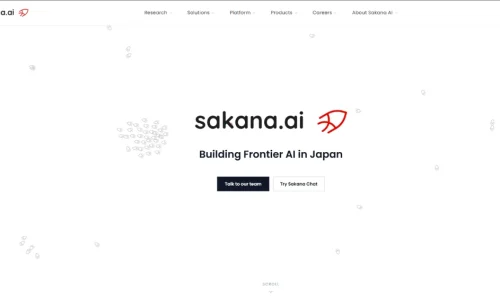
Sakana AI is a Japanese artificial intelligence company developing advanced AI models, autonomous agents, and research technologies inspired by nature, evolution, and collective intelligence. Founded in Tokyo in 2023, the company focuses on building efficient AI systems that combine different models rather than depending entirely on one large language model.
Its growing ecosystem includes Sakana Fugu for multi-model orchestration, Sakana Namazu for Japanese-language AI, Sakana Marlin for strategic research, and The AI Scientist for automated scientific discovery.
In 2026, Sakana AI is attracting attention from developers, researchers, and businesses interested in alternative approaches to AI development. This guide explores its technology, products, pricing, practical applications, and how it compares with other AI platforms.
What Is Sakana AI?
Sakana AI is a Tokyo-based AI research and development company founded in 2023 by David Ha, Ren Ito, and Llion Jones.
The company’s name and philosophy are inspired by nature, particularly schools of fish that move together and adapt to changing environments.
Rather than focusing exclusively on building increasingly large AI models, Sakana AI explores ways to combine existing models, evolutionary algorithms, and collaborative intelligence to improve AI performance and efficiency.
Its research covers several areas, including:
- Multi-agent AI orchestration
- Evolutionary model optimization
- Autonomous scientific discovery
- Japanese-language foundation models
- Recursive self-improving AI systems
- More efficient neural network architectures
The company also develops practical products for businesses and individual users.
Its approach is particularly interesting because it explores how multiple specialized AI systems can work together to solve problems that might be difficult for a single model.
How Does Sakana AI Work?
Sakana AI uses several approaches to develop intelligent systems, depending on the product or research project.
1. Collective Intelligence
Collective intelligence is one of the central ideas behind Sakana AI.
Instead of depending on one AI model for every task, its systems can combine multiple specialized models and coordinate their capabilities.
For example, one model might be particularly good at coding, another at reasoning, and another at reviewing information.
Combining their strengths can help produce better results on complex tasks.
2. Evolutionary AI
Sakana AI also explores evolutionary algorithms inspired by natural selection.
These systems can generate different solutions, evaluate their performance, and retain or improve promising approaches.
This method is useful for discovering algorithms, optimizing models, and exploring solutions that are difficult to design manually.
3. AI Research Automation
The company develops systems that automate parts of scientific research.
These systems can generate research ideas, write code, conduct experiments, analyze results, and prepare scientific papers.
The goal is to reduce repetitive research work and help scientists explore more possibilities.
Key Sakana AI Products and Features
Sakana AI has developed several products designed for different users and applications.
1. Sakana Fugu
Sakana Fugu is a multi-agent AI system that coordinates different language models through a single API.
Instead of sending every request to one model, Fugu dynamically selects and coordinates specialized models according to the task.
Its main versions include:
- Fugu: Balances performance and response speed for everyday work.
- Fugu Ultra: Focuses on maximum performance for complex reasoning, research, and coding.
- Fugu Max: Optimizes the balance between model performance and operating costs.
- Fugu Cyber: Specializes in cybersecurity reasoning, vulnerability research, and threat investigation.
Fugu is particularly useful for developers building AI applications that require complex reasoning or multiple model capabilities.
It also offers model-selection flexibility, helping organizations manage provider dependencies and certain privacy or compliance requirements.
2. Sakana Namazu
Sakana Namazu is a Japanese-specialized large language model designed to understand Japanese language, culture, and business communication.
It is built on the open model Kimi K2.6 and further tuned using Sakana AI’s in-house data.
Its capabilities include:
- Natural Japanese business communication
- Formal and professional email writing
- Web search
- Code execution
- Complex reasoning
- Business document processing
One important advantage is its focus on Japanese business conventions, including appropriate language and communication styles.
Developers can also integrate Namazu through an OpenAI-compatible API, making it easier to connect with existing applications.
3. Sakana Marlin
Sakana Marlin is an autonomous research agent designed to support strategic business decisions.
Unlike ordinary AI chatbots that provide relatively quick responses, Marlin can conduct extended research and reasoning sessions.
It can spend up to eight hours on continuous autonomous research, according to the company’s product documentation.
Its capabilities include gathering information, developing hypotheses, exploring websites, resolving conflicting information, and preparing detailed strategy reports.
Marlin is particularly relevant for:
- Business strategy teams
- Management consultants
- Mergers and acquisitions research
- Investment research
- Corporate planning
- Think tanks
Its main purpose is to help professionals spend less time collecting information and more time making informed decisions.
4. Sakana Translate
Sakana Translate is an AI-powered translation and proofreading product built on Sakana Namazu.
It supports Japanese, English, and Chinese, with particular attention to conversational language and appropriate communication styles.
Users can create translations for different contexts, including casual conversations, business emails, and formal documents.
This makes it useful for international businesses, translators, and professionals communicating with Japanese customers.
5. Sakana Chat
Sakana Chat is the company’s user-facing AI chat platform.
It provides access to Sakana’s models, including Fugu and Namazu, through a conversational interface.
Users can explore AI capabilities without building their own applications or integrating APIs.
It is a practical starting point for people who want to test Sakana AI’s technology before considering more advanced developer tools.
The AI Scientist: Sakana AI’s Research Innovation
One of Sakana AI’s most interesting research projects is The AI Scientist.
It is an experimental AI system designed to automate significant parts of the scientific research process.
The system can:
- Generate research ideas.
- Search relevant scientific literature.
- Develop experiment plans.
- Write and execute code.
- Analyze experimental results.
- Prepare scientific manuscripts.
- Perform automated reviewing.
In March 2026, research describing The AI Scientist was published in Nature.
A notable demonstration involved an AI-generated research manuscript that passed the first round of peer review for a workshop associated with a leading machine-learning conference.
However, this does not mean AI can independently replace scientists or guarantee valid scientific discoveries.
Human supervision remains essential for evaluating research quality, methodology, originality, and ethical considerations.
Sakana AI Pricing in 2026
Sakana AI offers different pricing structures depending on whether users access its products through the API platform or individual applications.
According to its official pricing page checked on November 9, 2026:
Sakana AI API Subscription Plans
| Plan | Monthly price | Best for |
| Standard | $20 | Everyday AI usage and experiments |
| Pro | $100 | Regular coding, research, and analysis |
| Max | $200 | Heavy and extended AI workloads |
These subscriptions apply to the Sakana AI API platform and include access to Fugu, Fugu Ultra, and Fugu Max.
Pay-As-You-Go API Pricing
| Model | Input per 1M tokens | Output per 1M tokens |
| Fugu Ultra | $5 | $30 |
| Fugu Max | $2 | $6 |
| Sakana Namazu | $0.95 | $4 |
Fugu’s standard model uses underlying-model-based billing, while Fugu Cyber has separate access and pricing arrangements.
Namazu also charges separately for built-in tools:
- Web search: $7 per 1,000 calls.
- Code execution: $0.12 per hour.
Sakana Chat does not have a subscription plan under this API pricing structure.
Pricing note: These are the rates listed on November 9, 2026. Sakana has announced scheduled pricing changes for Namazu beginning December 1, 2026, and standard Fugu beginning January 5, 2027. Check the official Sakana AI pricing page before purchasing.
Real-World Applications of Sakana AI
Sakana AI’s technology has potential applications across several industries.
1. Business Research and Strategy
Companies can use Sakana Marlin to research competitors, evaluate market opportunities, and prepare strategic reports.
This can help business teams organize large amounts of information before making important decisions.
2. Japanese Business Communication
Sakana Namazu and Sakana Translate can help international companies communicate with Japanese customers, employees, and business partners.
Their Japanese-focused capabilities are particularly useful for professional documents and formal communication.
3. Software Development
Developers can use Sakana Fugu to access coordinated AI capabilities for coding, debugging, and complex technical tasks.
Its multi-model architecture provides another approach to building AI-powered developer applications.
4. Scientific Research
The AI Scientist demonstrates how autonomous agents can support research activities, from generating ideas to running experiments and preparing manuscripts.
Researchers may use similar technologies to accelerate certain parts of their work.
5. Cybersecurity
Fugu Cyber focuses on security-related reasoning, including vulnerability research, threat investigation, and security analysis.
It is intended for specialized cybersecurity workflows rather than general-purpose chat.
Sakana AI vs. Other AI Companies
Sakana AI has a different approach from many established AI companies.
| AI company | Main focus | Key strength |
| Sakana AI | Multi-model intelligence and efficient AI research | Model orchestration |
| OpenAI | General-purpose AI models and applications | ChatGPT and developer APIs |
| Anthropic | Advanced language models | Claude and enterprise AI |
| Google DeepMind | Frontier AI research and products | Gemini and scientific AI |
Sakana AI is not simply a direct replacement for ChatGPT or Claude.
Its Fugu technology focuses on coordinating multiple models, while Namazu specializes in Japanese-language applications.
Its research in evolutionary systems and autonomous science also gives it a different technical direction.
For businesses, the right choice depends on whether they need a general-purpose assistant, a specialized language model, or a system that combines multiple AI capabilities.
Advantages and Limitations of Sakana AI
Advantages
- Innovative multi-model orchestration technology.
- Specialized Japanese-language AI capabilities.
- Autonomous research and strategic analysis tools.
- Developer-friendly API integration.
- Research in evolutionary and self-improving AI.
- Specialized products for cybersecurity and translation.
Limitations
- Some products are designed for specific markets and use cases.
- Advanced API usage can become expensive.
- Certain models have regional availability restrictions.
- Benchmark results do not guarantee performance on every real-world task.
- Complex autonomous research still requires human verification.
- The ecosystem is less familiar to many users than established AI platforms.
Conclusion
Sakana AI is an interesting company in the rapidly developing artificial intelligence industry.
Its focus on collective intelligence, evolutionary algorithms, multi-model orchestration, and autonomous research makes it different from traditional AI development approaches.
Products such as Fugu, Namazu, Marlin, and Sakana Chat demonstrate how its research can become practical tools for developers, researchers, and businesses.
Although the company is still developing its global product ecosystem, its research and specialized AI solutions make it worth following.
If you are interested in discovering new AI technologies, Sakana AI is a company worth exploring. Visit Sakana AI to learn about its latest models and research, and explore RentaAI for more AI tools, technology guides, software comparisons, and productivity resources.
Frequently Asked Questions
What is Sakana AI used for?
Sakana AI develops AI models and tools for multi-agent orchestration, Japanese-language processing, strategic research, translation, scientific discovery, and business automation.
Is Sakana AI free to use?
Some products offer ways to explore their capabilities, while API access has free or paid usage options depending on the service. Paid API subscriptions start at $20 per month.
Who founded Sakana AI?
Sakana AI was founded in 2023 by David Ha, Ren Ito, and Llion Jones. The company is headquartered in Tokyo, Japan.
What is Sakana Fugu?
Sakana Fugu is a multi-agent system that coordinates multiple AI models through a single API to solve complex tasks.
What is Sakana Namazu?
Sakana Namazu is a Japanese-specialized language model designed for natural Japanese communication, business tasks, web search, and code execution.