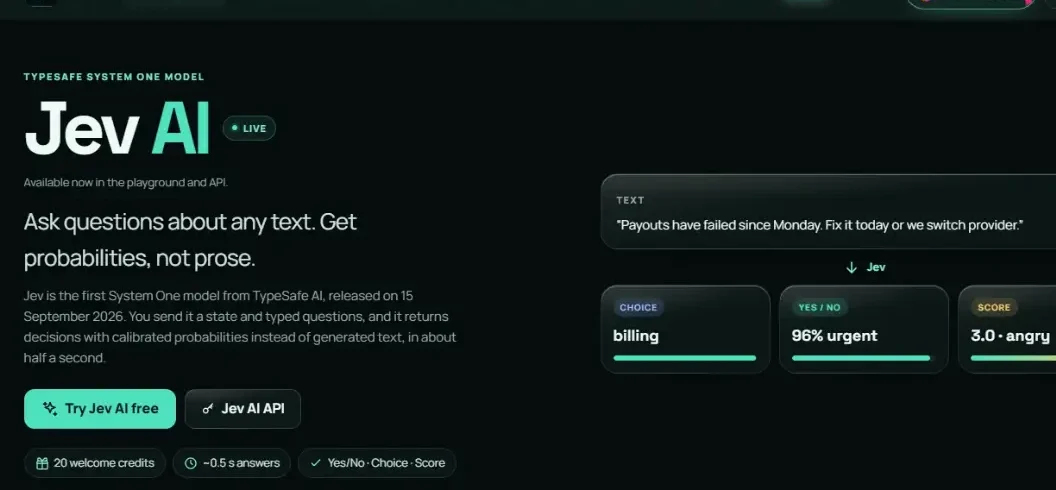

Jev AI Model is TypeSafe’s first System One model, built to make fast, structured decisions that software can use directly. Unlike traditional conversational AI models that generate text one token at a time, Jev produces typed decisions with probabilities and confidence estimates.
TypeSafe AI introduced Jev in September 2026 after spending about two years developing the technology in stealth. The company was founded by Diogo Almeida, who says his previous work at OpenAI included research that contributed to the methods behind ChatGPT and GPT-4.
The launch represents a different approach to AI automation. Instead of asking an AI model to generate a long response and then turning that response into something software can understand, Jev is designed to return structured values that applications can use as part of their own logic.
What Is the Jev AI Model?
Jev is a System One AI model designed for fast, structured decisions inside software.
Traditional large language models are excellent at generating text, answering questions, writing code, and handling conversations. However, software often needs something much simpler: a reliable decision.
For example, an application may need to determine whether a customer message is about:
- Sales
- Support
- Billing
- Technical problems
A traditional LLM might generate a response that then needs to be parsed and validated.
Jev takes a different approach. TypeSafe says developers can define the possible outputs in advance, allowing the model to return a typed decision with a probability or confidence estimate.
The basic workflow is:
Unstructured data → Jev → Structured decision → Software action
This makes Jev especially relevant to automated workflows where speed, predictable output, and uncertainty information matter.
How Is Jev Different From Traditional AI Models?
The biggest difference is how the models are designed to produce their outputs.
Traditional language models generally generate tokens sequentially. Each new token depends on the previous output. This approach works extremely well for conversation and content generation, but it can introduce latency and require additional processing when the final result needs to fit a strict software schema.
Jev is designed around parallel sampling.
According to TypeSafe, Jev generates structured outputs in a single query rather than producing a long sequence of tokens. Its outputs are also constrained to predefined types.
This means developers can use Jev for tasks such as:
- Classification
- Routing
- Scoring
- Data extraction
- Decision-making
- Workflow branching
- Verification
- Real-time applications
The goal is not to replace conversational AI. Instead, Jev targets a different part of the AI market: machine-facing intelligence for software automation.
What Are System One Models?
TypeSafe describes System One Models as a new class of AI models built specifically for decisions inside software.
The idea is simple. Instead of producing strings for humans to read, these models produce structured decisions that machines can immediately use.
TypeSafe says Jev’s outputs include calibrated probabilities and confidence estimates. This gives developers a way to decide when software should act automatically and when a case should be escalated for human review.
For example, a workflow could be configured so that:
- High-confidence decisions are processed automatically.
- Medium-confidence decisions receive additional checks.
- Low-confidence decisions are sent to a human.
This approach can give developers more control over how AI is integrated into production systems.
How Does Jev Work?
Jev uses three major ideas: a specialized model architecture, parallel sampling, and Reinforcement Learning for Calibrated Decisions (RLCD).
The parallel sampler is designed to produce structured outputs efficiently. Rather than generating a response token by token, Jev evaluates the available decision space and returns the required values.
TypeSafe also says Jev is designed to be hardware-aware, allowing its architecture to focus on efficient execution.
The other important component is confidence.
Every Jev decision includes an estimate of uncertainty. This is useful because production software does not always need an answer immediately. Sometimes it needs to know whether an answer is reliable enough to act on.
What Is RLCD?
RLCD stands for Reinforcement Learning for Calibrated Decisions.
TypeSafe developed RLCD as a training approach focused on calibrated probabilities rather than only generating preferred conversational responses.
Calibration is important for automation.
Suppose a model gives a prediction with 90% confidence. A well-calibrated system should have confidence estimates that meaningfully correspond to its actual accuracy over many similar predictions.
This does not mean a 90% prediction is guaranteed to be correct. Instead, confidence can help software determine when to automate a decision and when to request additional review.
TypeSafe positions RLCD as a key part of its effort to make AI decisions more useful inside production software.
How Fast Is Jev AI?
Speed is one of Jev’s major selling points.
TypeSafe reports 70–500 milliseconds for Jev’s end-to-end response time. The company compares this with several seconds for the frontier conversational models it evaluated.
TypeSafe also reports that certain workflow evaluations showed Jev operating up to 193.6 times faster than the comparison workflows.
These figures are TypeSafe’s own evaluation results, not an independent industry benchmark. The company explains that its comparisons used System One-shaped workflows and structured outputs, so they should be understood in that specific context.
For developers, however, the underlying goal is clear: make AI decisions fast enough for applications where traditional LLM latency can become a bottleneck.
How Much Does Jev Cost?
TypeSafe lists Jev’s input price at $0.042 per million tokens, or $42 per billion input tokens.
The company says output tokens are effectively free because Jev produces structured decisions rather than conventional generated text.
TypeSafe also highlights a reported 444.6x cost advantage in one of its System One workflow comparisons. Again, this is a company-reported result from its own evaluation setup rather than a universal price comparison for every AI workload.
The low-cost design is particularly relevant for applications processing large numbers of small AI decisions.
What Can Jev AI Be Used For?
Jev is designed for software that needs intelligence without requiring a long natural-language response.
1. AI-Powered Workflows
Jev can act like an intelligent decision layer inside ordinary application logic.
Developers can use structured decisions for routing, classification, scoring, and branching.
2. Real-Time Applications
Applications that require fast responses can benefit from low-latency decision models.
For example, software could analyze incoming state and select the next action without waiting several seconds for a conversational response.
3. Large-Scale Data Processing
TypeSafe also positions Jev for map-reducing over large datasets, where AI can transform huge amounts of information into structured features or
4. AI Agent Verification
Jev can also be used to evaluate or verify outputs from other AI systems.
For example, a developer could use a structured model to score an agent trace, classify an output, detect a problem, or decide whether human review is necessary.
TypeSafe specifically lists verification, guardrails, and detecting problematic AI outputs among its target applications.
5. Automated Branching Logic
Many software systems depend on large numbers of manually written rules.
Those rules can become difficult to maintain when real-world inputs are messy.
Jev is designed to act as a flexible decision layer where traditional if/else logic may be too rigid.
Can Jev Replace ChatGPT or Other LLMs?
No. Jev is designed for a different purpose.
ChatGPT-style models are built for human interaction, writing, coding, reasoning, and open-ended language tasks.
Jev is designed primarily for structured machine decisions.
A simple comparison looks like this:
| Feature | Jev | Traditional LLM |
| Main purpose | Programmatic decisions | Language generation |
| Output | Typed values | Generated text |
| Sampling | Parallel | Sequential |
| Confidence | Built into decisions | Usually estimated separately |
| Best use | Automation and workflows | Chat, writing, coding |
| Output structure | Predefined | Flexible |
This means developers may use both types of models in the same application.
A conversational model could generate an answer, while Jev could verify, classify, route, or score that answer.
Does Jev Eliminate AI Hallucinations?
TypeSafe says Jev’s structured design eliminates type errors and prevents the model from generating arbitrary output outside the predefined structure. Its website also describes Jev as having “zero hallucinations” in the context of its constrained decision format.
However, structured output should not be confused with perfect accuracy.
A model can still make an incorrect decision while returning a valid value.
For example, if an application allows only “Sales” or “Support,” Jev can be prevented from returning an invalid third category. But it could still incorrectly classify a message as “Sales.”
That distinction is important when deploying AI in real-world systems.
Why Is Jev Important for AI Automation?
The most interesting part of Jev is its focus on decisions instead of strings.
Modern AI has become extremely capable at generating language. But software does not always need language.
It often needs a simple answer:
- Route this request.
- Choose this action.
- Score this result.
- Approve or review this output.
- Extract this feature.
- Jev is designed around those types of tasks.
By combining structured outputs, confidence estimates, parallel sampling, and RLCD, TypeSafe is attempting to create an AI model that fits more naturally into production code.
Jev AI Early Access
TypeSafe launched Jev in September 2026 following approximately two years of development in stealth.
The company has opened access for developers and is positioning Jev toward engineering teams building AI-powered software and automated workflows.
As the product develops, its real-world performance will become clearer through broader developer adoption and independent testing.
Conclusion
Jev AI takes a powerful but focused approach to artificial intelligence: make decisions that software can use, rather than generate more text for humans to read.
TypeSafe’s first System One model combines structured outputs, parallel sampling, calibrated confidence, and RLCD to target fast AI automation.
The company’s early results report very low latency and low input costs, but those performance figures come from TypeSafe’s own evaluations and should be tested against independent workloads before making broad conclusions.
If Jev performs reliably across real production environments, its approach could give developers another powerful option for integrating AI into software—especially where speed, structured outputs, confidence, and scalable automation matter more than conversation.
Frequently Asked Questions
1. What is the Jev AI model?
Jev AI is TypeSafe’s first System One model, designed to make fast, structured decisions that software can use directly.
2. How is Jev different from traditional LLMs?
Jev focuses on structured decisions and parallel sampling, while traditional LLMs mainly generate text sequentially for conversations, coding, and other tasks.
3. How fast is Jev AI?
TypeSafe reports Jev response times of about 70–500 milliseconds, although actual performance can vary by workload and infrastructure.
4. What can Jev AI be used for?
Jev can support classification, routing, scoring, data processing, AI agent verification, workflow automation, and other programmatic decision tasks.
5. Can Jev AI replace ChatGPT?
No. Jev is designed for machine-facing decisions, while ChatGPT and similar LLMs are built for conversation, writing, coding, reasoning, and other language-based tasks.

Leave A Comment